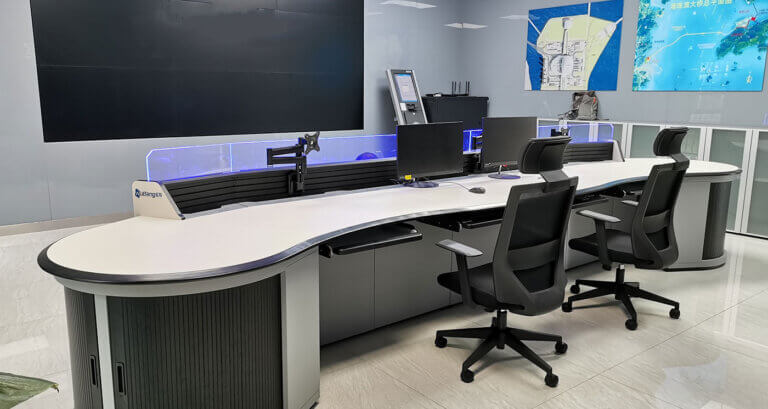
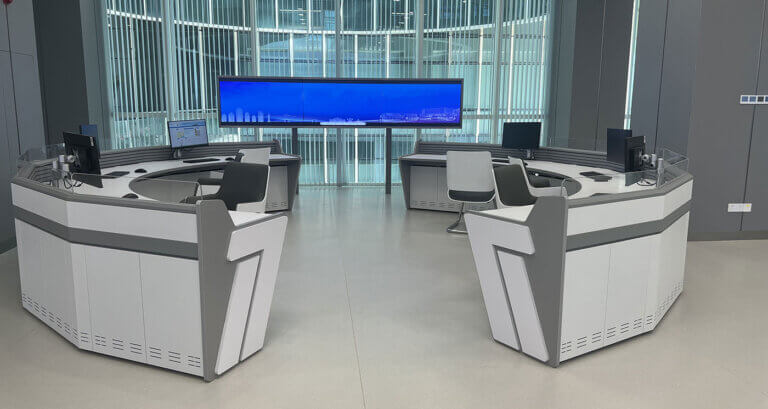
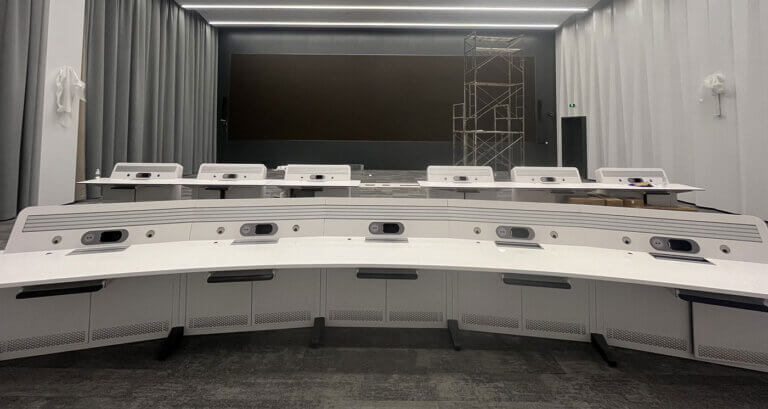

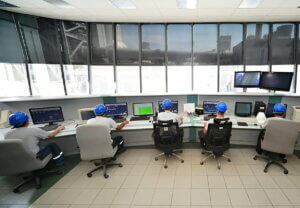
An air traffic control room is the technological and operational heart of aviation coordination. The purposefully-designed facilities contain radar displays, flight data systems, and communication tools operated by air traffic controllers to sequence aircraft and maintain continual safety oversight on air travel across a given region.
Control room teams have roles spanning traffic management, pilot communication, emergency response, and system coordination to guide aviation operations from taxi and takeoff to cruising routes and landing transitions.
Air traffic control rooms are highly specialized spaces that require careful planning and design. The layout of these facilities needs to facilitate teamwork, information sharing, focus, and rapid decision making.
Most air traffic control rooms feature a circular design to provide controllers with expansive views of airport runways and surrounding airspace through panoramic windows. They contain numerous radar screens and computer stations arranged efficiently to display real-time details on flight positions, altitudes, speeds, and weather conditions.
Controllers often work in semi-darkness since radar screens are easier to monitor without glare and ambient light. The lighting, temperature, background noise levels, and ergonomics of equipment and furniture play key roles in maintaining controller focus and minimizing fatigue over long shifts.
The smooth operation of an air traffic control room demands leaders who coordinate the talent, tools, and procedures involved in maintaining air safety. But what are the most vital functions carried out in these facilities?
One of the main priorities for air traffic control rooms is organizing the flow of airplanes through the skies in an orderly fashion. Controllers sequence departures and arrivals at nearby airports in a way that minimizes congestion and delays but still upholds sufficient separation between aircraft. Making decisions under pressure is crucial to avoiding collisions and keeping traffic running smoothly.
Clear communication represents the lifeblood of aviation coordination. Air traffic controllers maintain constant radio contact with pilots, issuing them instructions for takeoff, landing, taxiing, and more. This real-time guidance allows pilots to conduct flight procedures safely, navigate adverse weather, avoid potential hazards, and stay oriented whenever conditions get challenging.
While traffic management and communication make up the bulk of an air traffic controller’s work during normal operations, emergency situations introduce an entirely new dimension of critical importance.
Controllers must think on their feet, assessing dynamic factors in real-time to guide aircraft and airport vehicles, contacting emergency services as needed, and clearing space for emergency landings or distressed vehicles. Their decisions can mean the difference between disaster and deliverance during crises.
Behind the scenes, air traffic control rooms maintain connections to various other facilities to enable the smooth transition of aircraft through multiple airspaces. As planes travel over long distances, controllers hand off radar identification, communications, and monitoring duties to counterparts in adjoining centers or terminal control facilities. This coordination is vital for the continuity of flight oversight and traffic deconfliction.
Maintaining continually safe skies for modern air travel depends on coordinated teamwork between talented groups of aviation professionals.
The air traffic controllers carry out the bulk of the active management, communication, and emergency response duties outlined above. Their skills allow them to simultaneously monitor dozens of aircraft across a broad swath of skies.
Teams typically have one controller per sector of airspace tracking planes, plus added support for coordinating flight plan data, relaying critical safety updates to pilots, and managing complex traffic flows.
Supervisors oversee the air traffic controllers, providing a vital management layer for airspace supervision, staff coordination, situational awareness, and split-second decision making if abnormal situations arise. Some facilities have dedicated floors for supervisors to get a literal top-down view while coordinating facility operations using internal communications and data systems.
Behind the scenes, teams of technicians operate and maintain the vast array of radars, satellites, communications infrastructure, and data networks needed to feed real-time positioning and flight details to control room systems and personnel. Their work keeping mission-critical systems online allows controllers to have the data they need to make timely decisions.
Modern aviation coordination depends on specialized technology to track thousands of aircraft with precision, compile comprehensive data, and enable clear communication among pilots, controllers, and other stakeholders.
Specialized radar infrastructure forms the backbone for maintaining current situational awareness on flight positions. Primary and secondary radar systems transmit and receive radio signals that reflected off of an aircraft’s metal body, while newer ADS-B (Automatic Dependent Surveillance-Broadcast) technology relies on more precise onboard GPS satellites for positioning.
In addition to position tracking, these systems can determine altitude, speed, flight number, destination, and other details to help controllers maintain safe traffic flows. Controllers rely heavily on radar displays, so many rooms have redundant power and signal distribution to prevent even fleeting system outages.
Advanced software dashboards compile flight plan information from the FAA, commercial databases, and airlines to build detailed flight profiles tied to each aircraft’s radar target. Data such as flight origin, routing, requested altitudes, aircraft capabilities, destination airport, and more help controllers make smart decisions in sequencing arrivals, deconflicting traffic, and responding to pilot requests.
Some facilities even have flight data technicians who can rapidly update computer systems with flight amendments or strip out flight plans from the main system when needed for missed approaches, emergencies, or other non-routine situations.
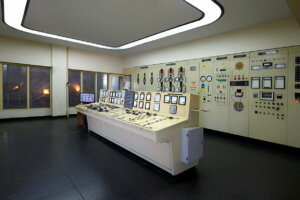
Clear radio communication represents an air traffic controller’s primary means for contacting aircraft crews for instructions, clearances, traffic advisories, and urgent updates. Consoles typically have panels of radio consoles tied to various frequencies to select the channel needed based on where a plane is located. Landline ring-down phones offer backup communication if radios go down. Facilities also have intercoms and headsets that let controllers coordinate internally when coordinating traffic or dealing rapidly evolving circumstances.
Monitoring hazardous weather represents a continual safety priority for aviation coordination. Air traffic control rooms utilize advanced meteorological systems to track regional storm fronts, turbulence, icing levels, wind shear, fog layers and other factors that can impact flight safety and routing options.
Controllers refers to this real-time weather data when issuing safety alerts to pilots about dangerous conditions ahead or when major weather threatens to reduce arrival and departure capacity at nearby airports.
While the flight tracking and coordination roles stay relatively similar across air traffic control sites, the actual physical facilities housing these rooms can vary dramatically depending on nearby airports and airspace structure.
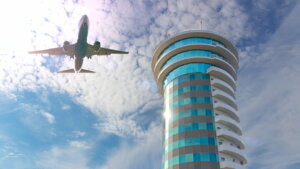
The iconic aviation image of a control tower involves facilities built right at commercial passenger airports to handle coordinating takeoffs, landings, and ground traffic. Local controllers stationed in these airport towers have visibility over runways and taxiways aided by surface movement radar systems to track all ground vehicles through ramps, taxiways and runways.
Since they have a limited visible range, approach and departure controllers stationed at major hub airports rely more on Radar systems for sequencing aircraft within roughly 30 miles of the airport, handing aircraft off to adjoining regional radar facilities once they leave that airspace range.
As intermediate guides between airport towers and regional enroute centers, Terminal Radar Approach Control (TRACON) facilities monitor the airspace roughly 30 to 50 miles around one or more major airports in their vicinity.
Using radar detection integrated with flight plan data, TRACON control rooms help guide aircraft through the busy transitional phase around airports with complex runway configurations or surrounding terrain and provide an added layer of redundancy for monitoring airport departures and arrivals. Major TRACON facilities located near New York, Chicago and other busy metroplexes monitor some of the most crowded airspace in the world during peak traffic hours.
As flights transit across states or even entire regions, aircraft monitoring and coordination responsibility shifts to a national network of Air Route Traffic Control Centers (ARTCCs) operated by the FAA. The twenty ARTCC facilities spread across the country oversee the majority of enroute airspace tracking and safety oversight once planes leave the more localized TRACON airspace surrounding busy airports.
Their control rooms have primary scopes and communication consoles devoted to each individual sector slice of the surrounding airspace at their facility (for example high vs low altitude). Where an airport tower may only actively monitor a few dozen aircraft at a time, these regional ARTCC facilities can be guiding hundreds of enroute jets to ensure adequate separation. Massive flight data processing systems aircraft position reports against flight plan routes to detect conflicts or spacing concerns.
While air traffic control rooms already harness specialized technology to safely coordinate congested skies, the aviation industry continues innovating to handle forecasted growth in passenger travel.
Some futuristic concepts propose transitioning certain repetitive flight path routings into automated and pre-cleared flows to shrink controller workload. This could allow controllers to focus more mental energy on dynamic flights and evolving conditions instead of issuing frequent predictable routing clearances.
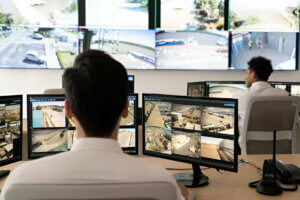
Remote tower technologies also show promise for augmenting windows with camera views fed through wall-sized screens for a wraparound view. Machine learning algorithms may help identify aircraft spacing concerns quicker with systems capable of learning from past operational data.
But even five or ten years down the road, the skilled air traffic control professionals, their refined procedures, and real-time adaptiveness to changing factors will remain crucial for harnessing advancing tools to achieve the prime goal: bringing passengers safely to their destination among the organized orchestration of metallic birds filling the skies.
Continual improvements in aviation infrastructure and procedures allow air traffic control rooms to safely handle growing volumes of passenger flights, but these skilled aviation personnel remain crucial for harnessing technology to achieve safe and efficient coordination amid perpetually crowded skies.
 English
  Russian
  French
  Italian
  German
  Japanese
  Korean
  Turkish
  Chinese
  Spanish
  Dutch
Dutch